
A man alone at the top. A man on the run. A man rewriting this sport’s record books.
This twelfth edition of The BreakPoint Notes feels like déjà vu. By now, it’s almost become a weekly routine.
The reason, as you’ve probably guessed, is always the same: Jannik Sinner.
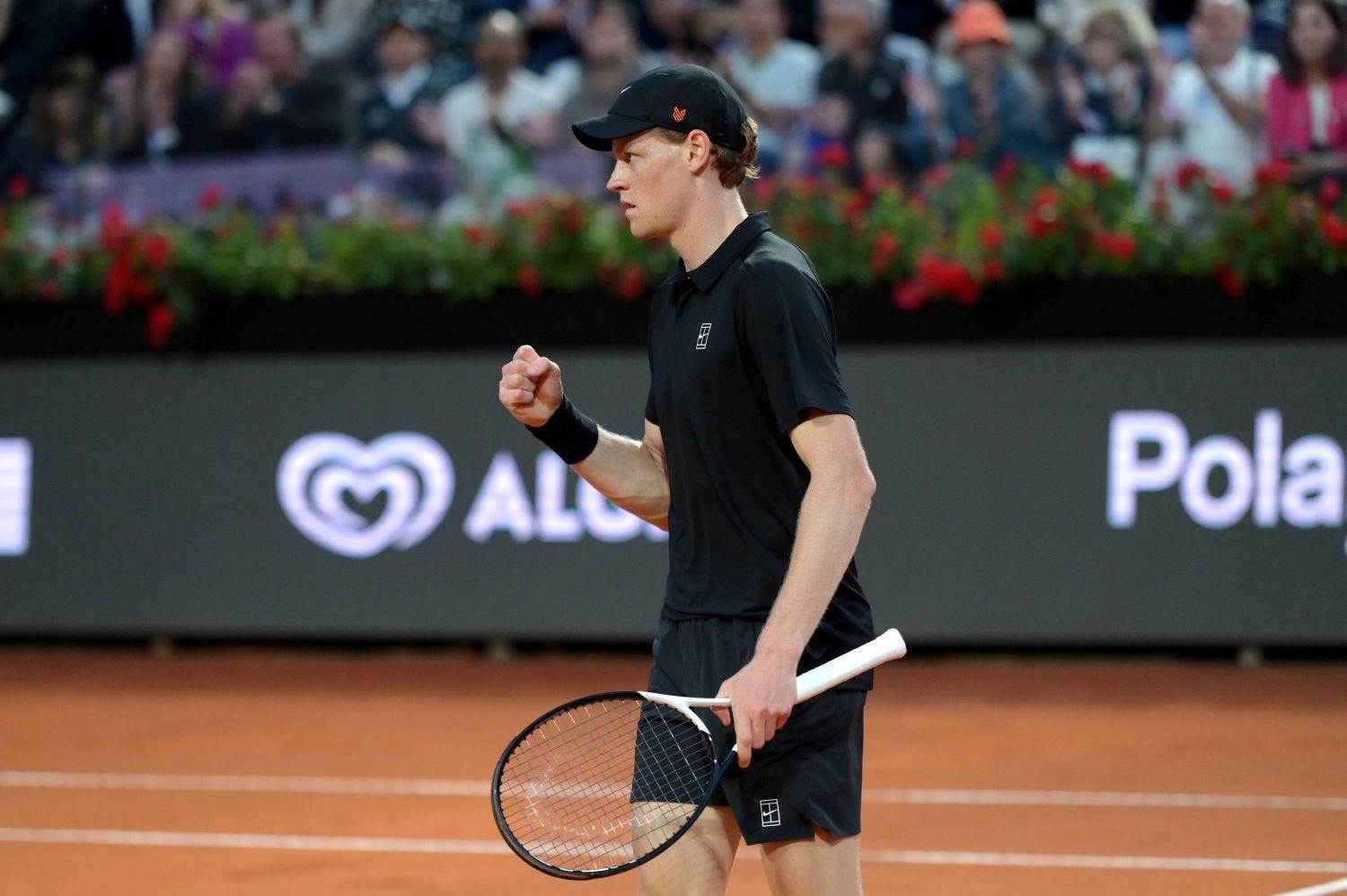
The world number one is more secure on the throne than ever and is going far beyond the simple (!) output of an elite athlete. He is monopolising the tennis narrative: headlines, minutes, analysis, storytelling. All of it is set to feel outdated within days, because what he does the following week is always even more.
In Madrid, another huge statement arrived: a fifth consecutive Masters 1000 final (never done before) and four out of four this season (also never done before). But the most striking figure is something else: the gap. Clear, obvious, almost disheartening. Right now, perhaps only a peak version of Alcaraz can genuinely sit at the same table. And even then, it’s still very much a match to be played.
Zverev has become, against his will, the clearest illustration of that gap: nine defeats in their last nine meetings, including the 2025 Australian Open and Madrid finals. In Spain, the German looked short of answers from the very start. Not a question of form. A question of solutions.
And perhaps that’s the most striking part: Sinner isn’t just winning, he’s taking away certainties. From everyone. Arthur Fils arrived full of momentum, fresh off the Barcelona title and playing eye-catching tennis. It wasn’t enough. He was outplayed before the match properly settled into a contest.
So the question hangs there: who can stop him?
At the moment, there’s no clear answer. Because Sinner, week after week, is doing something extremely rare: he’s “completing” tennis in real time. He still has Rome and Roland Garros as his immediate major targets — both without Alcaraz in the draw — before turning to the Olympic chapter, which is still entirely unwritten.
In the meantime, the numbers keep stacking up: 28 ATP titles at 24 years old, and who knows what other peaks he might still reach. Time will tell.
What else?
The WTA delivered a lively tournament, full of stories. Among them, Anastasia Potapova, who reached the semi-finals as a lucky loser, something no one had ever done before at WTA 1000 level.
In the final, Marta Kostyuk faced Mirra Andreeva. And Andreeva came within touching distance of another symbolic milestone: gifting herself the title for her 19th birthday, which fell on 29 April. It didn’t happen, but the message remains loud and clear.
She is the first teenager to reach three WTA 1000 finals in the current format (since 2009), a winner in Indian Wells and Dubai in 2025, and the youngest since Maria Sharapova to do so. She also came close to an early treble previously achieved by Kvitová, Svitolina, Garcia, Świątek and Sabalenka, but fell at the final hurdle.
The title went to Kostyuk: her first WTA 1000 final and, above all, a flawless clay-court season so far. Eleven matches, eleven wins, two titles (Rouen and Madrid). No cracks whatsoever.
And in Rome, who should we be watching?
On the men’s side, beyond the usual names, keep an eye on Rafael Jodar, who in Madrid showed flashes of something genuinely interesting. Then João Fonseca, now a regular feature among the circuit’s most intriguing young stories, and Stefanos Tsitsipas, who needs to build on the signs he showed at the Caja Mágica.
On the women’s side, it inevitably comes back to Iga Świątek: a tricky period, yes, but three Rome titles (2021, 2022, 2024) are not a detail. She remains one of the most reliable benchmarks ahead of Roland Garros.
The End
This brings us to the end of this edition of The BreakPoint Notes. Thanks for staying with us and for taking the time to read it. I hope you’ve enjoyed it up to this point and if you feel like leaving a comment, it would be very much appreciated.
The BreakPoint Notes will be back next week. Enjoy your week of tennis.