
It is difficult to imagine what Alexander Zverev must be feeling right now. Relief, probably. Satisfaction, certainly. And perhaps a touch of disbelief. The sense of finally reaching something that, for years, seemed within sight, almost within reach, yet never truly his.
Because the German has had to wait an entire sporting lifetime to get here. More than 4,300 days separate his first appearance on a Grand Slam court, in the qualifying rounds back in 2014, from this moment. In between came major titles, an Olympic gold medal, Masters 1000 titles, and years spent among the very best players in the world. Yet something always felt missing.
That title.
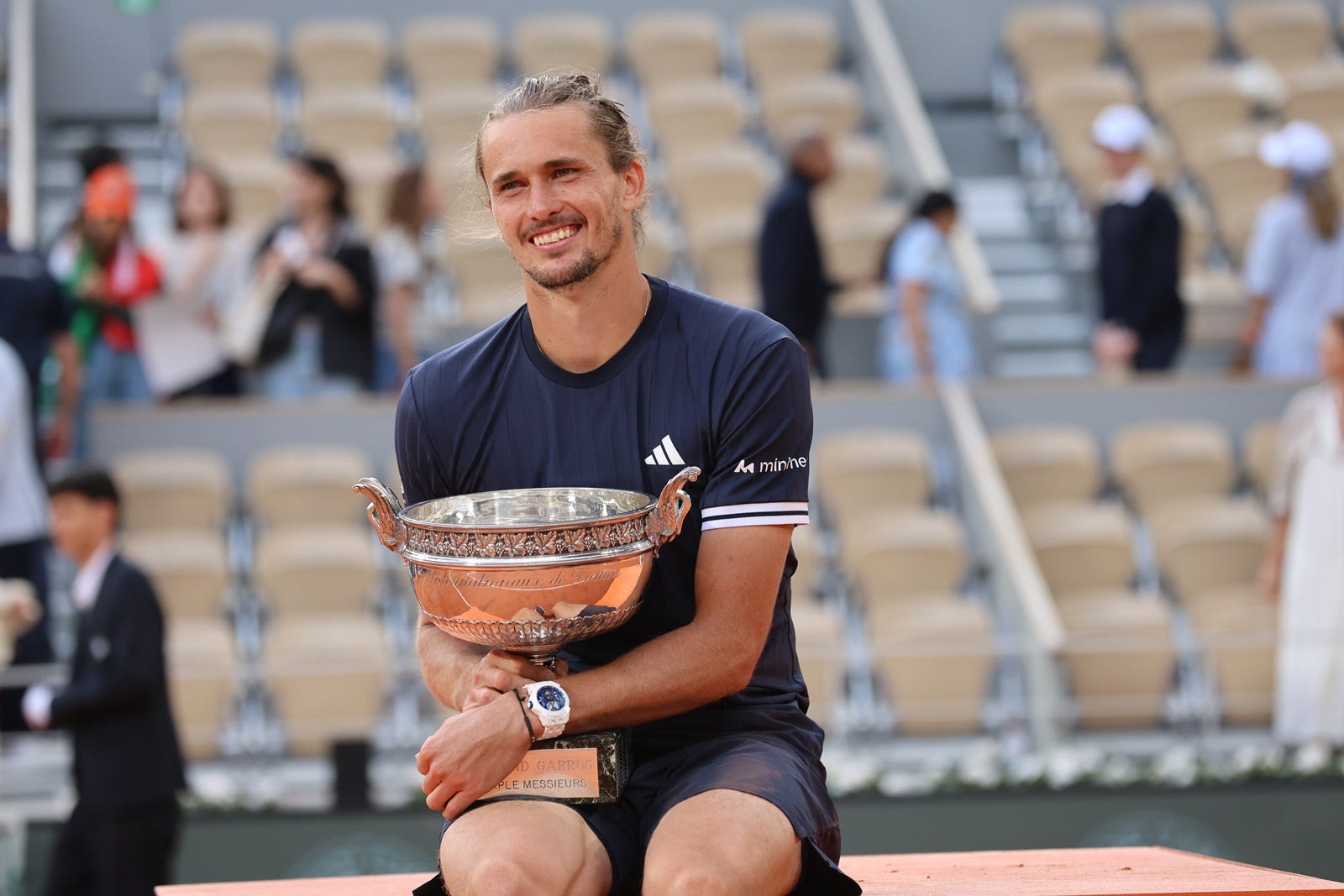
It took 29 years, three lost Grand Slam finals, and one of the most painful moments of his career: the ankle injury on Court Philippe-Chatrier in 2022, when he was arguably playing the best tennis of his life against Rafael Nadal. At the time, it felt like a moment that had taken away far more than a match. But it didn’t. In the end, after everything, Sascha got there.
Alexander Zverev is a Grand Slam champion.
He achieved it at the end of one of the most unusual and unpredictable Roland Garros tournaments in recent memory. A tournament that never saw defending champion Carlos Alcaraz take to the court and one that also lost Jannik Sinner almost immediately, the Italian falling in the second round after finding himself just minutes away from a victory that looked all but certain. From that point onwards, the draw opened up. But with opportunity came pressure.
And perhaps that was the real challenge.
For years, Zverev has carried the weight of expectation. This time, however, he managed it differently. Patiently. Calmly. Without allowing himself to be consumed by the fear that this might be his last great chance.
His route to the final was virtually flawless. Round after round, the draw thinned out. The other contenders because, by then, he was unquestionably the favourite, disappeared one by one. Eventually, there was only one player left standing across the net: Flavio Cobolli.
The Italian has enjoyed two weeks he will never forget. He played with freedom, courage and the kind of natural confidence that often belongs to those with nothing to lose and everything to gain. Friend off the court, opponent in the final, Cobolli came within touching distance of something that seemed to belong more to dreams than reality. In the stands sat Adriano Panatta, still the last Italian man to win Roland Garros, exactly fifty years after his triumph in Paris.
For a while, it genuinely felt possible.
But fate had other plans.
And, in a way, it rewarded Zverev in the manner most fitting for him: through a match full of twists and turns, nerves and tension, moments when everything seemed under control and others when old doubts came knocking once again. A few double faults. The inevitable pressure. The lingering feeling that the opportunity might still slip through his fingers.
Not this time.
This time the finish line was there, and he crossed it. Completely. Without hesitation. Without regret.
Well done, Sascha.
The women’s tournament was hardly short of surprises either.
Mirra Andreeva emerged as champion, confirming once again that she is one of the most compelling stories in modern tennis. Her freshness, her ability to handle the biggest moments, and the remarkable ease with which she approaches the sport’s most demanding occasions proved too much for Maja Chwalinska.
The Pole, however, deserves a chapter of her own.
For years she was regarded as one of Polish tennis’s brightest prospects, one who never quite fulfilled the promise many saw in her. Her career has been marked by setbacks, interruptions and a relationship with the sport that often seemed to swing between enthusiasm and frustration. Yet in Paris, something clicked. Starting in qualifying as the world number 118, she put together a remarkable run that carried her all the way to the final weekend of the tournament. This morning she woke up as the world number 21.
In her own way, she won this Roland Garros too.
Naturally, there is also a sense of disappointment surrounding some of the tournament’s leading favourites. Elena Rybakina, Iga Swiatek and, above all, Aryna Sabalenka were unable to turn expectations into results. For the world number one, there remains the additional frustration of failing to avenge last year’s final defeat to Coco Gauff, who herself exited the tournament earlier than expected.
But tennis rarely allows much time for reflection.
With Roland Garros now behind us, the calendar is already preparing to change its face. Clay will give way to grass, the fastest and most unpredictable surface in the sport. A living surface. In a few weeks’ time, the tennis world will move to Wimbledon, where the eight millimetres of grass at SW19 will once again decide who becomes the new king and queen of the summer.
And as always when Paris is left behind, one question hangs in the air: was what we witnessed over the past fortnight the culmination of a journey, or simply the beginning of a new story?